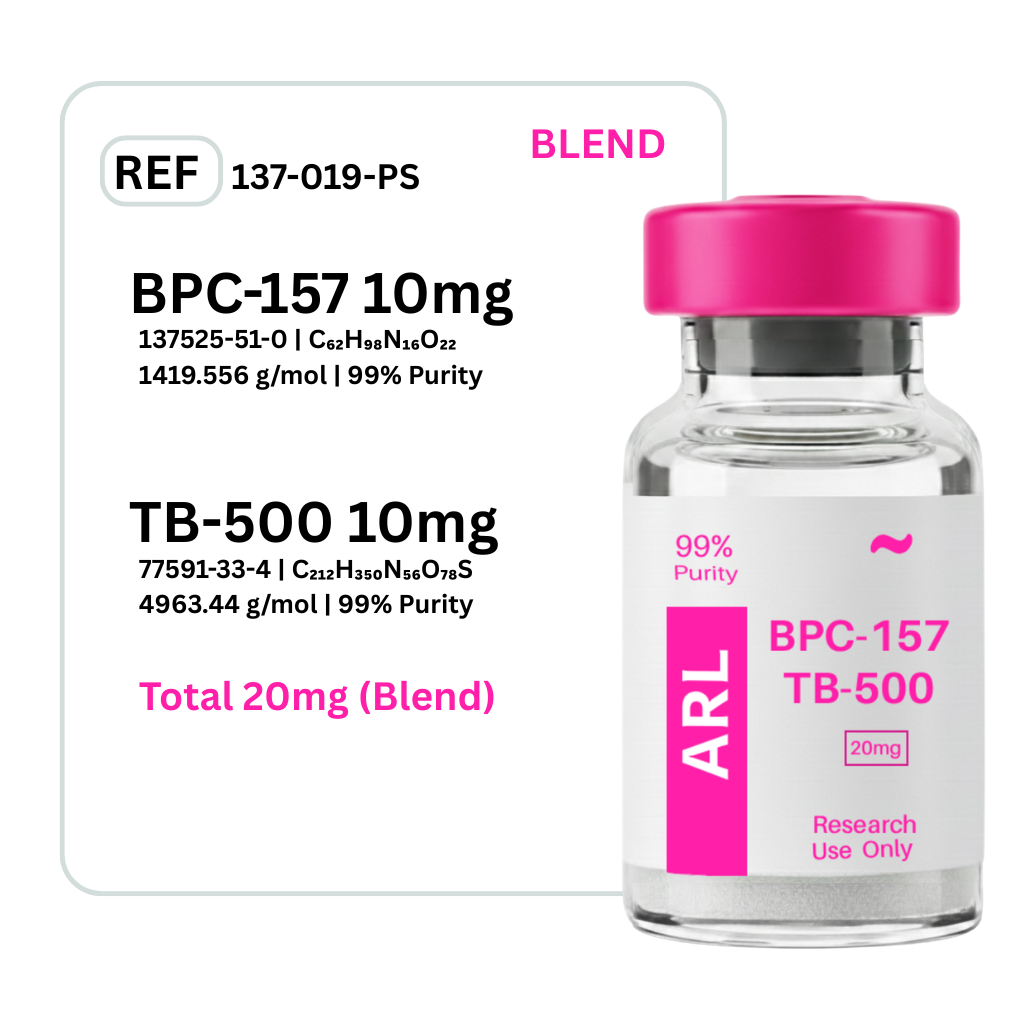
BPC-157 + TB-500
BPC-157 + TB-500
This batch of BPC-157 + TB-500 Peptide Blend has been third party lab tested and verified for quality.
Contents: BPC-157 + TB-500 Blend
Form: Powder
Purity: 99.4%
Couldn't load pickup availability
Free Reconstitution Solution automatically added to your cart with each order.
This product is Made, Tested & Shipped From United States.
Shipping & Delivery
We are committed to delivering fast, reliable, and transparent shipping for all orders. Please review our policy below for details on delivery times, tracking, and what to expect with every purchase.
View Full Shipping Policy
Verified+

Evidence-Based Analysis of Synergistic Potential: BPC-157 and TB-500 Combined Mechanism Study Design
Conceptual Framework: Defining Synergy
When two therapeutic agents are combined, three primary outcomes are possible: (1) synergistic effects where combined impact exceeds simple addition of individual effects, (2) additive effects where combined impact equals the sum of individual effects, or (3) sub-additive effects where combined impact falls below the sum of individual effects.
For BPC-157 and TB-500, mechanistic analysis predicts synergistic potential due to their distinct molecular mechanisms. However, mechanistic prediction alone doesn't establish actual synergy—empirical demonstration through appropriately designed studies is necessary.
Proposed Research Design Framework
Control Groups:
Optimal study design includes six control groups: (1) vehicle only (baseline healing), (2) BPC-157 alone, (3) TB-500 alone, (4) BPC-157 + TB-500 combination, (5) BPC-157 + TB-500 + collagen, and (6) full protocol including growth hormone stimulation.
This comparative design permits quantitative assessment of whether combination effects are additive, synergistic, or sub-additive.
Primary Outcome Measures:
Healing timeline metrics: Days to specific healing milestones (re-epithelialization, collagen deposition, wound closure). Cellular migration metrics: Migration speed of fibroblasts and immune cells measured through tracking assays. Fibroblast function metrics: Collagen synthesis rate, cellular proliferation rate, cellular viability under growth hormone stimulation.
Secondary Outcome Measures:
Tissue quality metrics: Collagen organization (through histological assessment), scar tissue quantity, mechanical strength of healed tissue. Molecular metrics: Actin concentration, growth hormone receptor density on fibroblasts, growth hormone signaling pathway activation status. Inflammatory metrics: Inflammatory cell infiltration, pro-inflammatory cytokine levels.
Dose-Response Analysis:
Rather than using fixed peptide doses, employ dose-response curves examining multiple doses of each peptide, alone and in combination. Response surface methodology can identify optimal dosing ratios and combinations.
Quantitative Synergy Assessment
Isobolographic Analysis:
Construct isobolograms plotting doses of each peptide on x and y axes, with contour lines representing constant efficacy levels. If combination effects are purely additive, observed data points fall on the predicted additive line. Synergistic effects manifest as data points below the additive line (lower total dose needed to achieve same effect).
Response Surface Analysis:
Three-dimensional surface modeling showing how outcome measures respond to varying doses of BPC-157 and TB-500. Surfaces displaying non-linear relationships between individual peptide doses and outcomes suggest potential synergistic mechanisms.
Mechanistic Validation Studies
Actin Dynamics:
Measure actin monomer concentrations (BPC-157 mechanism validation) and actin filament organization (TB-500 mechanism validation) under different peptide treatments. Combination treatment should demonstrate both enhanced actin concentration AND improved filament organization.
Growth Hormone Signaling:
Quantify growth hormone receptor density on fibroblasts (BPC-157 mechanism validation) and growth hormone-stimulated cellular responses under actin-limiting conditions (TB-500 mechanism validation). Combination treatment should demonstrate enhanced receptors that can be fully utilized due to adequate actin.
Expected Outcomes and Interpretation
Synergistic Scenario Interpretation:
If combination healing metrics significantly exceed additive predictions, this supports the theoretical synergistic mechanism model. Mechanistic validation studies showing enhanced actin AND enhanced fibroblast growth hormone responsiveness would further support synergistic mechanism hypothesis.
Additive Scenario Interpretation:
If combination effects approximately equal the sum of individual effects, the peptides work through complementary but non-synergistic mechanisms. This still demonstrates therapeutic value but suggests that sequential administration (BPC-157 followed by TB-500) might be sufficient rather than requiring simultaneous administration.
Sub-additive Scenario Interpretation:
If combination effects prove less than additive, potential antagonistic mechanisms exist. Mechanistic validation studies would be essential to identify interaction points and modify the approach accordingly.
Study Design Rigor Considerations
Blinding and Randomization:
Studies should employ randomized, blinded designs where experimenters remain unaware of treatment group assignment, reducing bias in outcome measurement.
Sample Size:
Power calculations should ensure adequate sample sizes to detect synergistic effects if present. Underpowered studies risk failing to detect true synergy.
Multi-Site Validation:
Optimal evidence derives from multiple independent laboratories reproducing the same findings. Inter-laboratory variation assessment validates the robustness of observed effects.
Translational Implications
If synergistic effects are demonstrated and mechanistically validated, this justifies combined administration of both peptides despite increased complexity and cost compared to single-peptide approaches. If only additive effects are observed, single-peptide approaches might be more cost-effective, though combination therapy might still provide clinical advantage in specific contexts where simultaneous addressing of multiple healing limitations proves beneficial.
Author Contribution
Dr. E. Logan, M.D., compiled the preceding research methodology framework through synthesis of contemporary study design principles and wound healing research literature. Professional credentials: Case Western Reserve University School of Medicine doctorate, molecular biology undergraduate degree.
Scientific Expertise
Dr. Allen L. Goldstein, MD, contributed scientific perspective as a distinguished researcher in thymosin beta-4 and immunological peptide therapeutics, currently holding the Catherine B. & William McCormick Chair in Biochemistry and Molecular Biology at George Washington University School of Medicine and Health Sciences (since 1978). Career includes foundational thymosin beta-4 characterization work, over 400 peer-reviewed publications, over 15 U.S. patents, academic text editorship, consulting roles with research and industrial institutions. Professional service: co-founder of The Institute for Advanced Studies in Immunology and Aging, Albert Sabin Vaccine Institute board member, Vice Chairman at BioPeptide Corporation. Education: B.S. from Wagner College (1959), M.S. and Ph.D. from Rutgers University (1961, 1964). Academic positions: Albert Einstein College of Medicine faculty (1964-1972), University of Texas Medical Branch Galveston biochemistry faculty (1972-present).
Transparency Disclosure: Dr. Goldstein maintains no commercial relationships with Peptide Sciences or cited practitioners.
References
Chang, C.-H., Tsai, W.-C., Lin, M.-S., Hsu, Y.-H., and Pang, J.-H. S. "Mechanisms of pentadecapeptide BPC 157 in tendon healing: cellular outgrowth, viability, and migration," Journal of Applied Physiology, vol. 110, no. 3, pp. 774-780, October 2013.
Kim, J. and Jung, Y. "Thymosin beta-4 involvement in hepatic fibrosis development," International Journal of Molecular Sciences, vol. 16, no. 5, pp. 10624-10635, May 2015.
Chang, C.-H., Tsai, W.-C., Hsu, Y.-H., and Pang, J.-H. S. "BPC 157 influence on growth hormone receptor expression in tendon fibroblasts," Molecular Biology Switzerland, vol. 19, no. 5, pp. 19066-19077, November 2014.
Inflammatory and endocrine relationships in rheumatic disease. Clinical Rheumatology, vol. 31, pp. 1253-1258, 2012.
Philp, D., et al. "Thymosin β4 roles in tissue regeneration, injury repair, and follicular biology," Age-Related Changes and Development, vol. 125, no. 2, pp. 113-119, February 2010.
-

SECURELY MANUFACTURED
Products developed in certified, regulated labs.
-

MODERN LOGISTICS
Fast and efficient 3-5 day shipping.
-

ALWAYS MONITORING
Our team is ready to assist 24/7.
You may also like
-
SAVE 25%Reconstitution Solution
Regular price $15.00Regular price $15.00 Sale priceUnit price / per$20.0025% -
Lemon Bottle Complex - Research Grade Lipolytic Compound Blend
Regular price $80.00Regular price $80.00 Sale priceUnit price / per$105.0023% -
SAVE 25%Tirzepatide
Regular price From $50.00Regular price From $50.00 Sale priceUnit price / per$67.0025% -
SAVE 24%Thymosin Alpha-1
Regular price From $79.00Regular price From $79.00 Sale priceUnit price / per$104.0024% -
SAVE 23%Tesamorelin
Regular price From $80.00Regular price From $80.00 Sale priceUnit price / per$105.0023% -
SAVE 23%Survodutide
Regular price $299.00Regular price $299.00 Sale priceUnit price / per$392.0023% -
SAVE 26%Sterile Water
Regular price From $14.00Regular price From $14.00 Sale priceUnit price / per$19.0026% -
SAVE 23%SLU-PP-332
Regular price $125.00Regular price $125.00 Sale priceUnit price / per$164.0023% -
SAVE 23%Sermorelin
Regular price From $70.00Regular price From $70.00 Sale priceUnit price / per$92.0023% -
SAVE 23%Semaglutide
Regular price From $36.00Regular price From $36.00 Sale priceUnit price / per$47.0023% -
SAVE 23%Retatrutide Triple Agonist
Regular price From $90.00Regular price From $90.00 Sale priceUnit price / per$118.0023% -
SAVE 26%Oxytocin Acetate
Regular price $42.00Regular price $42.00 Sale priceUnit price / per$57.0026% -
SAVE 25%Melanotan II (MT2)
Regular price $50.00Regular price $50.00 Sale priceUnit price / per$67.0025% -
SAVE 24%Lipo-C with B Vitamins
Regular price $85.00Regular price $85.00 Sale priceUnit price / per$112.0024% -
SAVE 23%Lipo-C - Premium Research Peptide
Regular price $80.00Regular price $80.00 Sale priceUnit price / per$104.0023% -
Lemon Bottle - Premium Research Peptide
Regular price $80.00Regular price $80.00 Sale priceUnit price / per$105.0023% -
L-Carnitine - Premium Research Peptide
Regular price $97.00Regular price $97.00 Sale priceUnit price / per$127.0023% -
SAVE 24%KPV Tripeptide
Regular price From $56.00Regular price From $56.00 Sale priceUnit price / per$74.0024% -
KLOW Blend - GHK-CU + TB-500 + BPC-157 + KPV 10mg
Regular price $200.00Regular price $200.00 Sale priceUnit price / per$261.0023% -
SAVE 23%Kisspeptin-10
Regular price From $65.00Regular price From $65.00 Sale priceUnit price / per$85.0023% -
SAVE 23%Ipamorelin
Regular price From $32.00Regular price From $32.00 Sale priceUnit price / per$42.0023% -
SAVE 24%IGF-1 LR3 (Long R3)
Regular price From $40.00Regular price From $40.00 Sale priceUnit price / per$53.0024% -
SAVE 24%Hyaluronic
Regular price $28.00Regular price $28.00 Sale priceUnit price / per$37.0024% -
SAVE 23%HGH Fragment 176-191
Regular price $97.00Regular price $97.00 Sale priceUnit price / per$127.0023% -
SAVE 23%HGH 191AA (Somatropin)
Regular price From $55.00Regular price From $55.00 Sale priceUnit price / per$72.0023% -
SAVE 25%Gonadorelin
Regular price $50.00Regular price $50.00 Sale priceUnit price / per$67.0025% -
SAVE 23%Glutathione
Regular price $83.00Regular price $83.00 Sale priceUnit price / per$109.0023% -
SAVE 23%Glow BPC-157 + GHK-CU + TB-500
Regular price $139.00Regular price $139.00 Sale priceUnit price / per$181.0023%
Every vial we sell comes from a lab that follows current Good Manufacturing Practices (cGMP). That means each step of production is documented and controlled. Before a batch is released, it’s tested by independent third-party labs for purity, identity, and sterility. Certificates of analysis are available so you can see the exact test results.
Yes. The labs we work with use ISO-certified clean rooms where air quality, equipment, and handling procedures are tightly regulated. Staff are trained to pharmaceutical-grade standards. This ensures the peptides are produced in an environment that minimizes contamination risks.
Peptides in lyophilized (freeze-dried) form are stable at room temperature for transport. Once you receive them, refrigeration is recommended to maintain long-term integrity. We package every order securely to prevent damage and ship promptly, so your vials arrive in optimal condition.
We operate under strict in-house protocols that follow current Good Manufacturing Practices (cGMP). That means our team oversees the entire process from sourcing raw amino acids to the final lyophilized vial. Nothing is outsourced or repackaged. This gives us full control over purity, consistency, and sterility, and it’s why we can stand behind every single vial we ship.
Store them in the refrigerator, away from direct light and heat. If you need to keep them longer, some peptides can be stored frozen. Each vial comes with clear handling instructions so you know the proper conditions for stability.
The strongest proof is transparency. For every peptide, we can provide certificates of analysis, manufacturing documentation, and references to the published scientific research behind it. If you ever have questions, we’ll show you the data rather than ask you to take our word for it.
The difference is transparency. Most sites give you a product name and a price. We provide full batch testing, lab documentation, and direct access to certificates of analysis so you don’t have to guess what you’re getting. When you order from us, you know exactly what’s in the vial, where it was made, and how it was verified.