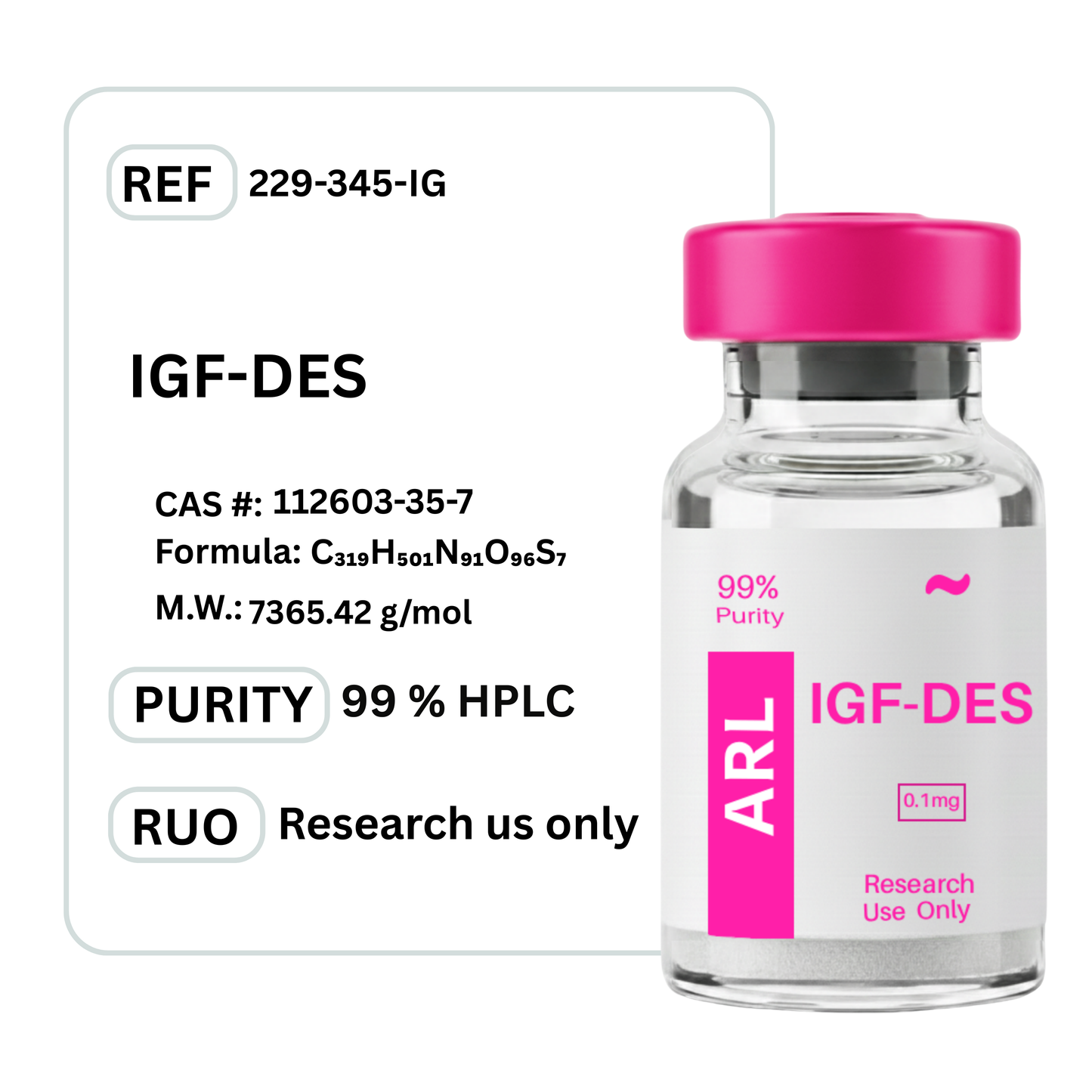
IGF-DES
IGF-DES
This batch of IGF-DES Peptide has been third party lab tested and verified for quality.
Contents: IGF-DES (Insulin-Like Growth Factor-1 DES(1-3) Analog)
Form: Powder
Purity: 99.3%
Couldn't load pickup availability
Free Reconstitution Solution automatically added to your cart with each order.
This product is Made, Tested & Shipped From United State.
Shipping & Delivery
We are committed to delivering fast, reliable, and transparent shipping for all orders. Please review our policy below for details on delivery times, tracking, and what to expect with every purchase.
View Full Shipping Policy
Verified+

Chapter: IGF-1 DES – Structure, Mechanism, and Therapeutic Potential
Introduction to IGF-1 DES
Insulin-like growth factor-1 (IGF-1) represents one of the body's most important signaling molecules. It promotes cell division, supports tissue repair, and maintains neurological function throughout life. However, a naturally occurring variant called IGF-1 DES offers substantial advantages over the original molecule.
IGF-1 DES is an engineered or naturally occurring form of IGF-I in which the tripeptide sequence Gly-Pro-Glu is removed from the N-terminus. This variant occurs naturally in human brain tissue, bovine colostral secretions, and porcine reproductive tissues. The structural modification, though minimal, creates dramatically different biological behavior.
Key Characteristics of IGF-1 DES
Potency Enhancement: IGF-1 DES demonstrates approximately 10-fold greater potency than standard IGF-1 in promoting both hypertrophic and hyperplastic cellular responses.
Bioavailability Advantage: Unlike standard IGF-1, which binds extensively to IGF-I binding proteins (IGFBPs), IGF-1 DES shows negligible binding affinity for these regulatory proteins. This allows substantially all circulating IGF-1 DES to remain bioavailable and active.
Extended Duration: IGF-1 DES exhibits a prolonged half-life in circulation, extended peak activity levels, and delayed clearance compared to standard IGF-1.
Clinical Potential: The compound shows promise for treating catabolic conditions (chronic wasting diseases) and inflammatory bowel disorders.
Molecular Mechanism of Enhanced Potency
The superior potency of IGF-1 DES results directly from its inability to bind IGFBPs. When standard IGF-1 enters circulation, IGFBP proteins immediately bind to it, sequestering the molecule and preventing receptor engagement. IGF-1 DES, by contrast, remains unbound and available for receptor activation.
This distinction produces measurable biological consequences. At equivalent molar concentrations, IGF-1 DES activates cellular receptors with substantially greater efficiency than standard IGF-1. Experimental evidence from porcine models and mammalian cell cultures confirms these enhanced potency characteristics reproducibly.
Pharmacokinetic Profile
The extended circulatory residence of IGF-1 DES creates a favorable pharmacokinetic profile characterized by:
- Extended latency period before initial effect manifestation
- Significantly elevated peak concentration levels
- Substantially prolonged duration of action
- Reduced metabolic clearance rates
These characteristics offer potential advantages for managing hyperglycemic conditions and metabolic dysregulation.
Metabolic Effects
Research demonstrates that IGF-1 DES influences glucose homeostasis through multiple mechanisms. The peptide stimulates glucose uptake by muscle, neural, and hepatic tissues. This increased cellular glucose extraction reduces circulating blood glucose concentrations. The resulting glycemic reduction triggers secondary metabolic adjustments including reduced adipose tissue accumulation and decreased circulating insulin levels.
IGF-1 DES maintains anabolic (muscle-building) properties even under energy-restricted conditions. Rodent studies demonstrated that 14-day IGF-1 administration produced measurable improvements in:
- Body weight parameters
- Nitrogen balance and muscle protein retention
- Metabolic conversion efficiency
Dosimetric optimization proves critical, as excessive IGF-1 concentrations paradoxically reduce therapeutic effectiveness through mechanisms requiring further clarification.
Neurological Applications and Mechanisms
Fundamental Role of IGF-I in Neurodevelopment
IGF-I participates in multiple aspects of neuronal development, maturation, and maintenance. The peptide influences:
- Neuronal proliferation and differentiation
- Pre-synaptic vesicular formation and function
- Neurotransmitter synthesis and release mechanisms
- Synaptic plasticity and long-term potentiation/depression
- Neuronal survival and apoptosis resistance
Inadequate IGF-I availability during critical developmental windows disrupts normal synaptic development and impairs long-term potentiation mechanisms, potentially contributing to neurodevelopmental disorders.
IGF-1 DES and Autism Spectrum Disorders
Comparative neurochemical analysis documents that autistic children display measurably reduced cerebral IGF-I concentrations relative to neurotypical populations. This deficiency becomes particularly prominent during early developmental stages when neural circuits form.
Murine model investigations employing genetically engineered organisms demonstrate that IGF-II and IGF-1 DES can reverse behavioral deficits associated with autism spectrum disorders. Treatment paradigms spanning just 5 days produced:
- Normalization of behavioral conditioning responses
- Reduction of perseverative/repetitive behaviors
- Improvement of grooming patterns
- Enhancement of spatial memory processing
Notably, these improvements persisted following treatment cessation, suggesting sustained neuroplasticity modifications.
Cognitive Function and Aging
IGF-I plays developmental roles in childhood and maintenance roles throughout adulthood. In pediatric populations, IGF-1 DES shows greater therapeutic potential than standard IGF-I. In adult populations, IGF-1 variants demonstrate efficacy in reducing amyloid-beta accumulation—a pathological feature of Alzheimer disease and Parkinson disease.
The capacity of IGF-1 DES to cross the blood-brain barrier more effectively than standard IGF-1 suggests advantages for central nervous system application.
Immunological Mechanisms
IGF-I receptor expression occurs on multiple immune cell types including B lymphocytes, T lymphocytes, dendritic cells, and neutrophils. IGF-1 DES demonstrates superior potency relative to standard IGF-1 in:
- Neutrophil activation and pathogen elimination
- Macrophage function enhancement
- Intestinal barrier integrity maintenance
- Mucosal tissue regeneration support
Oncological Applications
Cancer cells characteristically demonstrate undifferentiated or uncontrolled proliferative status. IGF-1 and IGF-1 DES can induce cellular differentiation, potentially reducing proliferative rates. Avian leukemic cell models demonstrate that these peptides effectively promote differentiation mechanisms in malignant cells.
Wound Healing and Tissue Regeneration
Dermal fibroblasts represent the principal cellular population responsible for post-injury tissue repair. These cells synthesize the extracellular matrix required for tissue regeneration. IGF-I receptor activation on fibroblasts drives tissue regeneration processes. By utilizing peptides unaffected by IGFBP binding (such as IGF-1 DES), researchers can potentially enhance healing outcomes in compromised tissue environments.
Safety and Administration Considerations
IGF-1 DES demonstrates moderate adverse effect potential in preclinical investigations. Oral and subcutaneous injectable formulations display excellent bioavailability in murine models. However, murine dosimetric parameters do not directly translate to human physiology, requiring additional clinical investigation.
IGF-1 DES remains restricted to educational and research purposes. This compound is not approved for human consumption.
Conclusion
IGF-1 DES represents a compelling research tool offering substantial advantages over standard IGF-1 across multiple therapeutic domains. Its enhanced potency, extended duration, superior blood-brain barrier penetration, and unique bioavailability profile position it as an ideal investigative agent for examining novel treatment approaches in neurodevelopmental disorders, metabolic conditions, and other IGF-I-responsive pathologies. Continued research will likely expand understanding of its therapeutic potential and mechanisms of action.
References
[1] F. J. Ballard, J. C. Wallace, G. L. Francis, L. C. Read, and F. M. Tomas, "Des(1-3)IGF-I: a truncated variant of insulin-like growth factor-I," Int. J. Biochem. Cell Biol., vol. 28, no. 10, pp. 1085–1087, Oct. 1996
[2] F. M. Tomas, P. C. Walton, F. R. Dunshea, and F. J. Ballard, "IGF-I variants that bind minimally to IGF-binding proteins display more potent and extended hypoglycaemic action compared to native IGF-I in pigs and marmoset monkeys," J. Endocrinol., vol. 155, no. 2, pp. 377–386, Nov. 1997
[3] P. E. Walton, F. R. Dunshea, and F. J. Ballard, "In vivo actions of IGF analogues with reduced affinities for IGFBPs: metabolic and growth effects in pigs of different ages and GH responsiveness," Prog. Growth Factor Res., vol. 6, no. 2–4, pp. 385–395, 1995
[4] F. J. Ballard, P. C. Walton, S. Bastian, F. M. Tomas, J. C. Wallace, and G. L. Francis, "Effects of interactions between IGFBPs and IGFs on the plasma clearance and in vivo biological activities of IGFs and IGF analogs," Growth Regul., vol. 3, no. 1, pp. 40–44, Mar. 1993
[5] R. Camboni, "New experimental treatments for core social domain in autism spectrum disorders," Front. Pediatr., vol. 2, p. 61, 2014
[6] J. Costales and A. Kolevzon, "The Therapeutic Potential of Insulin-Like Growth Factor-1 in Central Nervous System Disorders," Neurosci. Biobehav. Rev., vol. 63, pp. 207–222, Apr. 2016
[7] R. Riikonen, "Insulin-Like Growth Factors in the Pathogenesis of Neurological Diseases in Children," Int. J. Mol. Sci., vol. 18, no. 10, Sep. 2017
[8] A. B. Steinmetz, S. A. Stern, S. A. Kohtz, G. Descalzi, and C. M. Alberini, "Insulin-Like Growth Factor II Targets the mTOR Pathway to Reverse Autism-Like Phenotypes in Mice," J. Neurosci. Off. J. Soc. Neurosci., vol. 38, no. 4, pp. 1015–1029, 24 2018
[9] D. Ebrahim-Fakhari and M. Sahin, "Autism and the synapse: emerging mechanisms and mechanism-based therapies," Curr. Opin. Neurol., vol. 28, no. 2, pp. 91–102, Apr. 2015
[10] D. C. Gómedo, M. Beresiewicz, and B. Zablocka, "Neuroprotective effects of short peptides derived from the insulin-like growth factor 1," Neurochem. Int., vol. 51, no. 8, pp. 451–458, Dec. 2007
[11] M. M. Ramsey, M. M. Adams, O. J. Ariwodola, W. E. Sonntag, and J. L. Weiner, "Functional characterization of des-IGF-1 action at excitatory synapses in the CA1 region of rat hippocampus," J. Neurophysiol., vol. 94, no. 1, pp. 247–254, Jul. 2005
[12] X. Zhao, B. W. McBride, L. M. Trouten-Radford, and J. H. Burton, "Effects of intramuscular injection of insulin-like growth factor analogues on bovine hydrothermal protein release by neutrophils and basophils by mononuclear cells," J. Endocrinol., vol. 139, no. 2, pp. 245–252, Nov. 1993
[13] M. E. Yaleman, D. C. Clattey, S. C. Ceyfen-Hughes, V. J. Frost, J. A. Ward, and J. M. Holly, "Cytokines modulate the sensitivity of human fibroblasts to stimulation by insulin-like growth factor-I (IGF-I) by altering endogenous IGF-binding protein production," J. Endocrinol., vol. 137, no. 1, pp. 151–159, Apr. 1993
[14] M. Ramade-Bonnet, F. Gamouille, F. al Alie, M. Roccanilora, J. Menville, and G. Perilliere, "Effects of IGF-I and IGF-I on insulin-like growth factor-I/insulin receptor and its potential IGF-II autocrine loop, promotes the differentiation of human colon cancer cells," Int. J. Cancer, vol. 52, no. 3, pp. 457–473, Oct. 1992
[15] J Clin Invest. 2004;113(1):25-27. https://doi.org/10.1172/JCI200420660.
-

SECURELY MANUFACTURED
Products developed in certified, regulated labs.
-

MODERN LOGISTICS
Fast and efficient 3-5 day shipping.
-

ALWAYS MONITORING
Our team is ready to assist 24/7.
You may also like
-
SAVE 25%Reconstitution Solution
Regular price $15.00Regular price $15.00 Sale priceUnit price / per$20.0025% -
Lemon Bottle Complex - Research Grade Lipolytic Compound Blend
Regular price $80.00Regular price $80.00 Sale priceUnit price / per$105.0023% -
SAVE 25%Tirzepatide
Regular price From $50.00Regular price From $50.00 Sale priceUnit price / per$67.0025% -
SAVE 24%Thymosin Alpha-1
Regular price From $79.00Regular price From $79.00 Sale priceUnit price / per$104.0024% -
SAVE 23%Tesamorelin
Regular price From $80.00Regular price From $80.00 Sale priceUnit price / per$105.0023% -
SAVE 23%Survodutide
Regular price $299.00Regular price $299.00 Sale priceUnit price / per$392.0023% -
SAVE 26%Sterile Water
Regular price From $14.00Regular price From $14.00 Sale priceUnit price / per$19.0026% -
SAVE 23%SLU-PP-332
Regular price $125.00Regular price $125.00 Sale priceUnit price / per$164.0023% -
SAVE 23%Sermorelin
Regular price From $70.00Regular price From $70.00 Sale priceUnit price / per$92.0023% -
SAVE 23%Semaglutide
Regular price From $36.00Regular price From $36.00 Sale priceUnit price / per$47.0023% -
SAVE 23%Retatrutide Triple Agonist
Regular price From $90.00Regular price From $90.00 Sale priceUnit price / per$118.0023% -
SAVE 26%Oxytocin Acetate
Regular price $42.00Regular price $42.00 Sale priceUnit price / per$57.0026% -
SAVE 25%Melanotan II (MT2)
Regular price $50.00Regular price $50.00 Sale priceUnit price / per$67.0025% -
SAVE 24%Lipo-C with B Vitamins
Regular price $85.00Regular price $85.00 Sale priceUnit price / per$112.0024% -
SAVE 23%Lipo-C - Premium Research Peptide
Regular price $80.00Regular price $80.00 Sale priceUnit price / per$104.0023% -
Lemon Bottle - Premium Research Peptide
Regular price $80.00Regular price $80.00 Sale priceUnit price / per$105.0023% -
L-Carnitine - Premium Research Peptide
Regular price $97.00Regular price $97.00 Sale priceUnit price / per$127.0023% -
SAVE 24%KPV Tripeptide
Regular price From $56.00Regular price From $56.00 Sale priceUnit price / per$74.0024% -
KLOW Blend - GHK-CU + TB-500 + BPC-157 + KPV 10mg
Regular price $200.00Regular price $200.00 Sale priceUnit price / per$261.0023% -
SAVE 23%Kisspeptin-10
Regular price From $65.00Regular price From $65.00 Sale priceUnit price / per$85.0023% -
SAVE 23%Ipamorelin
Regular price From $32.00Regular price From $32.00 Sale priceUnit price / per$42.0023% -
SAVE 24%IGF-1 LR3 (Long R3)
Regular price From $40.00Regular price From $40.00 Sale priceUnit price / per$53.0024% -
SAVE 24%Hyaluronic
Regular price $28.00Regular price $28.00 Sale priceUnit price / per$37.0024% -
SAVE 23%HGH Fragment 176-191
Regular price $97.00Regular price $97.00 Sale priceUnit price / per$127.0023% -
SAVE 23%HGH 191AA (Somatropin)
Regular price From $55.00Regular price From $55.00 Sale priceUnit price / per$72.0023% -
SAVE 25%Gonadorelin
Regular price $50.00Regular price $50.00 Sale priceUnit price / per$67.0025% -
SAVE 23%Glutathione
Regular price $83.00Regular price $83.00 Sale priceUnit price / per$109.0023% -
SAVE 23%Glow BPC-157 + GHK-CU + TB-500
Regular price $139.00Regular price $139.00 Sale priceUnit price / per$181.0023%
Every vial we sell comes from a lab that follows current Good Manufacturing Practices (cGMP). That means each step of production is documented and controlled. Before a batch is released, it’s tested by independent third-party labs for purity, identity, and sterility. Certificates of analysis are available so you can see the exact test results.
Yes. The labs we work with use ISO-certified clean rooms where air quality, equipment, and handling procedures are tightly regulated. Staff are trained to pharmaceutical-grade standards. This ensures the peptides are produced in an environment that minimizes contamination risks.
Peptides in lyophilized (freeze-dried) form are stable at room temperature for transport. Once you receive them, refrigeration is recommended to maintain long-term integrity. We package every order securely to prevent damage and ship promptly, so your vials arrive in optimal condition.
We operate under strict in-house protocols that follow current Good Manufacturing Practices (cGMP). That means our team oversees the entire process from sourcing raw amino acids to the final lyophilized vial. Nothing is outsourced or repackaged. This gives us full control over purity, consistency, and sterility, and it’s why we can stand behind every single vial we ship.
Store them in the refrigerator, away from direct light and heat. If you need to keep them longer, some peptides can be stored frozen. Each vial comes with clear handling instructions so you know the proper conditions for stability.
The strongest proof is transparency. For every peptide, we can provide certificates of analysis, manufacturing documentation, and references to the published scientific research behind it. If you ever have questions, we’ll show you the data rather than ask you to take our word for it.
The difference is transparency. Most sites give you a product name and a price. We provide full batch testing, lab documentation, and direct access to certificates of analysis so you don’t have to guess what you’re getting. When you order from us, you know exactly what’s in the vial, where it was made, and how it was verified.